
SEO vs Google Ads: Which Should a Home Service Business Pay For First?
With about $1,000 a month, which comes first: getting found or Google Ads? What each buys, how long each takes, what stops when you stop paying, and a four-question test.

The short answer
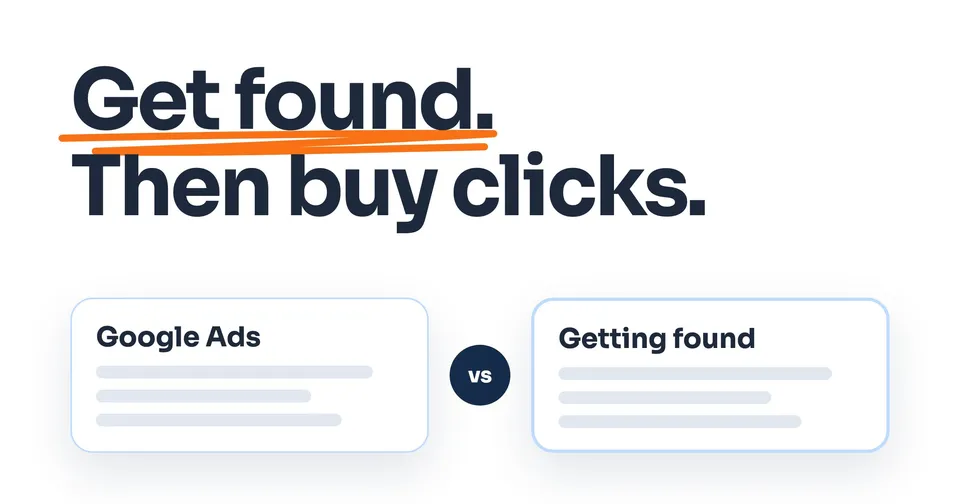
If $1,000 a month is your whole budget, getting found usually comes first. Your Google listing is free, and Google says no one can pay for a better map ranking. At LocaliQ's $90.92 median home services lead, $1,000 of ads buys about 11 leads, and they stop the day the spending stops.
The rest of this guide shows you how.
On this page
Google's own answer to this question is that it depends on your goals: "If your goal is to drive traffic to your [website] in the short term, you might choose to focus on PPC ads. If you want to enhance your business's online presence in the long run, SEO is the answer." That's true, and it doesn't tell an owner where the first $1,000 should go.
Below: what $1,000 buys on each side, how long each takes, what's left when you stop paying, then four checks. Every figure is sourced at the end, with the date we read it. None of it is a result from one of our clients.
What each one actually is
Two different things get called "showing up on Google." One is paid: Google Ads, which marketers also call PPC, pay per click, because you pay Google each time someone taps your ad. The other is free: your website in the regular results, and your Google Business Profile, the listing on the map with your reviews and the Call button. Getting those to show up is what SEO, search engine optimization, means.
Google is clear about where the line sits. "There's no cost to appear in organic search results like Google's," organic being Google's word for the regular results, and "creating a Business Profile and listing your business on Google is free." Paying for ads "won't improve your organic search rankings," and for the map, "There's no way to request or pay for a better local ranking on Google."
Money spent on one doesn't spill over into the other.
What $1,000 a month buys in Google Ads
Google has no floor: "There's no minimum ad spend, and you can set a daily or monthly cap that works for your business." A $1,000 month is an average daily budget of about $32.89. Google can spend up to twice that, about $65.79, on a busy day, but for most campaigns never more than your $1,000 across the month.
Now the number Google won't give you: what a lead costs. Cost per lead is what you pay Google for each person who calls or fills out a form from your ad. LocaliQ, an ad company that publishes what its home services campaigns pay, puts that at $90.92 in its 2025 report, across 3,211 US campaigns. That's a median, the middle campaign, so a few extreme accounts don't skew it. That means $1,000 a month buys about 11 leads, about two and a half a week.
Then the part only you know: your close rate, the share of leads you book. A booked job is a lead that turned into work on the schedule. If you book 1 in 3, those 11 leads are about 3.7 booked jobs, and each one cost about $272.76 in ad spend. Hold that next to your average job. If a job brings in less, more budget only loses more.
Your trade can move this fivefold. At LocaliQ's roofing and gutters median of $228.15 a lead, the same $1,000 buys about 4.4 leads, about 1.5 booked jobs at 1 in 3, and $684.45 per booked job. At the pools and spas median, $45.15, it buys about 22. What Google Ads costs a contractor, trade by trade has the full table.
If someone runs the ads for you, their fee comes on top of the $1,000. We don't run ads below $2,000 a month in ad spend, so a $1,000 budget is below what we would take on.
What $1,000 a month buys in getting found
This side doesn't buy a counted number of leads. It buys work you keep: a website that turns a visit into a call, a Google listing with every service and area filled in, a habit of asking every customer for a review, and a page for each job people actually search for. How much that brings in depends on how many people search for your trade in your area and how strong the other listings are, so no honest quote puts a cost per lead on it up front.
Google says local results are mainly based on three things, in its own words. Relevance: "how well a Business Profile matches what someone is searching for." Distance: "how far each business is from the customer who's searching." Prominence: "how well-known a business is." You can't do much about distance. Work can improve the other two.
It usually comes first for a plain reason: every ad sends a paid click to the same website. When Google places your ad, it weighs "The quality of your ads and landing page," the landing page being the page your ad sends people to, and says "Higher quality ads can often lead to lower CPCs," a lower cost per click. A website that doesn't turn visits into calls makes every click cost more and return less.
How long each one takes
Ads can bring calls the day the campaign is approved and running.
Getting found is slower, and nobody can hand you a date. Google's own guide says: "Some changes might take effect in a few hours, others could take several months. In general, you likely want to wait a few weeks to assess whether your work had beneficial effects in Google Search results." Its page on hiring help gives no timeline at all; it tells you to ask: "What kind of results do you expect to see, and in what timeframe?"
The top marketing articles on this question say "several months", "three to six months" or "6-12 months", and none cites a study for it. In our experience, it would be unusual not to see a real difference after 90 days. That is not a promise of a ranking or a number of calls.
Ads cost money from day one and can bring calls from day one. Getting found costs money from day one and can bring calls later. That gap is the real price of going with getting found first.
What stops when the spending stops
Pause a campaign, and Google's help is plain: it "stops your ads from showing to audiences and prevents you from accruing further charges." No spend, no calls from ads, starting that day.
Your Google listing costs nothing to keep, and a website in your name stays up as long as it's hosted. Whoever does the work, the website and the listing should be in your name, so the work stays when the bill stops. What you built keeps working in a month you pay no one for marketing. It won't hold its spot forever without upkeep, since other businesses keep adding reviews and pages, but it doesn't vanish when the payments stop.
Which one comes first: four checks, in order
Each check you fail is something to fix before a dollar goes to ads.
1. Can people find you without paying?
Search your trade and your town on your phone. Is your listing there, filled in, with recent reviews? Does your website show up? If not, every customer who finds you on Google costs a click. Start with why a business doesn't show on Google, and whether Google can see your website.
2. Does your website turn a visit into a call?
Ads pay for the click; the website has to earn the call. A phone number people can tap and buttons that say what happens next do more for your cost per lead than raising your bid.
3. Does the math clear?
Take your monthly budget and divide it by your trade's cost per lead. That's your leads. Multiply by your close rate, and that's your booked jobs. At $1,000 a month and $90.92 a lead, booking 1 in 3, each job has to bring in about $273 just to cover the ads. A roofer at $228.15 a lead needs about $684. If your average job clears that with room to spare, ads can pay. If it doesn't, more months at the same cost per lead won't fix it. And if you can't tell which calls came from where, track your calls before you judge anything.
4. Do you have room for more work?
Extra leads are wasted if nobody can take the job. If the schedule is full, or daytime calls go to voicemail, fix that before you buy leads.
When ads should come first
If your listing is solid, your website gets calls, your crew has room and the math clears at your budget, ads are the faster lever, and the one you can buy. In the trades with cheaper leads, in the chart above, a smaller budget buys enough leads to judge; the job still has to clear the math. And a storm or a heat wave doesn't wait for rankings: ads reach people this week. If you need calls this month, your website already turns visits into calls and the math clears, run ads while getting found builds.
When getting found should come first
If check 1 or 2 fails, or the math only clears at a budget you don't have. For a $1,000 budget in most trades, that's the likely answer, and it's what Foundation is for.
Many businesses end up running both. The question is only which comes first. If you can spend $2,000 a month or more, have room for the work and the numbers clear, the calculator below works out an Acquisition month and how many booked jobs at your average job it takes to cover it.
Try it with your numbers
Work out your monthDrag to your budget and your average job
- Ad spend, paid to the platform
- $2,000
- Our fee
- $1,249
- Your total month
- $3,249
- Booked jobs to cover it
- 4
Our fee stays at $1,249 until your ad spend passes $5,000 a month.
Jobs to cover it means revenue from booked jobs at your average job, before your own costs. Your margin decides the real profit.
People also ask
Which is better, Google Ads or SEO?
Neither wins on its own; they do different jobs. Ads bring calls the day they run and stop when the spending stops, while your listing is free, and getting found is slower to build and keeps working. With about $1,000 a month, getting found usually comes first, and ads earn their place once your cost per booked job is below your average job.
Does running Google Ads help my SEO?
No. Google says its ads "won't improve your organic search rankings," and its Business Profile help says there's no way to pay for a better local ranking. What ads can give you is information: the search terms report shows the actual searches that triggered your ads, which tells you which pages are worth building.
Can I run SEO and Google Ads at the same time?
Yes, and many growing service businesses end up doing both. The order matters more than the mix: get found and make sure your website turns visits into calls, then add ads when your schedule has room and the math clears. We only run ads at $2,000 a month in ad spend or more, so below that we point people to getting found first.
When should I pick SEO over Google Ads?
When people can't find you without paying, when your website doesn't yet turn visits into calls, or when your budget divided by your trade's cost per lead gives too few leads to judge. At LocaliQ's roofing and gutters median of $228.15 a lead, $1,000 a month buys about 4 leads. Getting found is also the only one of the two that keeps working in a month you spend nothing on marketing.
How much does getting found cost?
Being listed costs nothing: Google says creating a Business Profile is free, and there is no cost to appear in the regular results. What costs money is the work: a website that turns visits into calls, a filled-in listing, and a habit of asking every customer for a review. You can do some of it yourself or pay someone; either way, get a written list of what the money buys each month.
Sources
- Google, SEO vs. PPC: Understanding the Difference, read 25 September 2026.
- Google, Get your business on Google with a free Business Profile, read 25 September 2026.
- Google Business Profile Help, Tips to improve your local ranking on Google, read 25 September 2026.
- Google Ads, How Google Ads works, read 25 September 2026.
- Google Ads Help, About average daily budgets, read 25 September 2026.
- Google Ads Help, Enable, pause, or remove a campaign, read 25 September 2026.
- Google Ads Help, About Ad Rank, read 25 September 2026.
- Google Ads Help, About the search terms report, read 25 September 2026.
- Google Search Central, SEO Starter Guide, read 25 September 2026.
- Do you need an SEO? (Google Search Central), read 25 September 2026.
- LocaliQ, Search Advertising Benchmarks for Home Services (last updated 15 July 2026), read 25 September 2026.
- HawkSEM, SEO vs. Google Ads: Which Works Best?, read 25 September 2026.
- Pathlabs, SEO vs Google Ads: Why You Need Both, read 25 September 2026.
- Todaymade, SEO vs. Google Ads: Which One Drives Better Results?, read 25 September 2026.
Keep Reading
 Stage 2: Acquisition Google Ads for Contractors: What It Costs and What to Track What a lead costs in your trade, and how to judge ads by booked jobs. 12 min read · Read the Guide →
  Stage 1: Foundation Why Is My Business Not Showing Up on Google? 6 Checks Get found without paying for every click, starting with your listing. 7 min read · Read the Guide →
  Stage 1: Foundation How to Track Phone Calls From Your Website Know which calls came from ads and which came from search. 9 min read · Read the Guide →