
How to Get Lawn Care Customers, and What Each Source Costs
Where lawn care customers come from, what each source costs, which ones other pros get too, and how to check it against a season of mows.

The short answer
Add stops on the streets you already mow, from your Google listing, your reviews and your neighbors, which cost nothing per customer. Pay for ads, lead websites or apps only when a new customer costs less than a season of mowing brings in. Search ads ran a median $117.92 a landscaping lead in LocaliQ's 2025 benchmarks.
The rest of this guide shows you how.
On this page
- Price a lawn customer by the season, not the mow
- Search ads: $117.92 a lead, and fewer clicks become leads
- Local Services Ads: lawn care is on Google's list
- Lead websites and lawn care apps: who else gets the lawn, and who keeps it
- Free sources: your Google listing, reviews, website and Nextdoor
- The streets you already mow: neighbors, referrals and route mail
- Every source, side by side
- Just starting out?
- Which source to add first, and when
The cheapest lawn care customer is the one on a street you already mow. Start with the sources that charge nothing per customer: your Google listing, your reviews and the neighbors who watch your crews work. Then pay for more only where a new customer costs less than a season of their visits brings in.
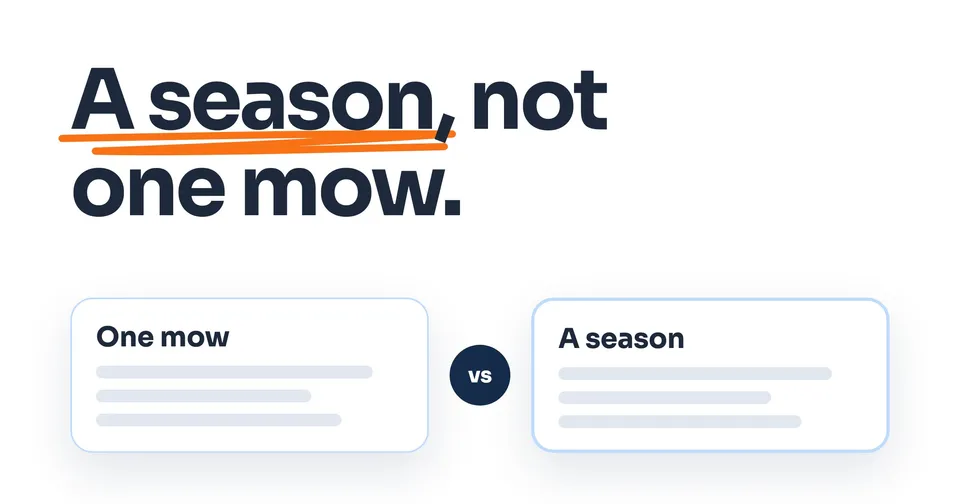
That season is what sets lawn care apart. In LocaliQ's 2025 benchmarks, a landscaping lead from search ads had a median cost of $117.92, so if you book 1 in 3, each new customer costs about $353.76 in ad spend. Unless one mow brings in more than that, the customer has to stay a while to pay it back. Here's what each source costs, and who else gets the lawn.
Price a lawn customer by the season, not the mow
Cost per lead is what one call or form about a lawn costs you. Close rate is the share of those homeowners who sign up, like 1 in 3. Divide cost per lead by close rate and you get your cost per new customer.
A lawn gets cut as fast as it grows: Illinois Extension says to take off no more than "one-third of the grass leaf in a single cutting," which in spring "will likely mean more than once a week." So hold a new customer's cost against a season of their visits, not one mow. LawnStarter, a lawn care app, quotes homeowners $42 to $68 to mow a typical suburban lot. At those prices, the $353.76 above takes about 5 to 8 mows to earn back, before your own costs.
Where the customer lives matters too. GreenPal, an app where pros bid on lawns, names a lawn's "proximity to a vendor's current lawns" on their route as one of the three biggest things that set a pro's price. A stop on a street you already mow adds less driving than one across town.
Search ads: $117.92 a lead, and fewer clicks become leads
LocaliQ studied 3,211 home services search campaigns in the US, on Google and Microsoft, for its 2025 benchmarks. It has no lawn care category. Landscaping is the closest, at a median of $117.92 a lead, about 1.3 times the home services figure of $90.92.
Two things push landscaping up. Its $8.76 click cost about 12% more than the $7.85 home services median, and fewer of those clicks became leads: 6.42%, against 7.33%.
If we run the ads, add our fee. On Acquisition, the plan where we run them, the smallest month is $2,000 of ad spend plus our $1,249. At 1 in 3, that $3,249 comes to about $575 for each new customer; book half your leads and it's about $383. Set that beside what one customer pays you in a season. A one-time customer rarely covers it; one on your route all season might. For the other trades' figures and the settings worth checking, see what Google Ads costs a contractor.
Two settings fit a route. Google lets you aim ads at "regions, cities, or postal codes" or a radius, so put them where your trucks already go. Google warns that a very small area "might only show intermittently or not at all." And pause the ads in the months your route is full.
Local Services Ads: lawn care is on Google's list
You pay Google for each lead these ads bring, not each click, and the ads carry the Google Verified badge. Google lists both "Lawn care" and "Landscaper" among the home services that qualify. It also says the ads are available "only for certain service categories," and tells you to check your eligibility to see if they run in your area. Its screening of your business varies by category and location.
There's no price list. Google says a lead's price moves with your location, the type of job, the type of lead and your bidding mode. Judge them by what you pay per lead, divided by the share you book.
Three settings fit a lawn route. You pick your service area by city, county or ZIP code, and can leave ZIP codes out, so draw it around the ZIP codes your routes cover. You can set the ad to paused when the season ends or the route is full. And pick up the phone: Google says "Missed calls may negatively affect your responsiveness," and responsiveness helps decide where your ad shows.
Google named lawn care among the first trades it started shifting into Google Ads in August 2026, and says "You still only pay for valid leads." It lists service-area businesses without a storefront for late 2026, so check which group you're in. Our guide to Local Services Ads costs covers that change and the math.
Lead websites and lawn care apps: who else gets the lawn, and who keeps it
Lead websites hand you homeowners who already asked for help. Read their rules before you pay. Angi's help center says it matches each homeowner's request with "no more than five pros." It also says: "You are charged for leads whether or not you open or respond to them."
Lawn care has its own apps, and they charge differently: they book the mowing and take a cut of every visit. On GreenPal, a homeowner gets "up to 5 grass cutting bids," and the pro who wins pays GreenPal a 5% fee every time a payment for a finished job goes through. Stripe charges separately for card processing. GreenPal doesn't set the price: each pro bids their own. LawnStarter sets the price itself, using its own software "to price each lawn," and keeps a commission on every completed job. Its jobs are matched by location, which can fill a route. But the homeowner signs up with LawnStarter, and LawnStarter tells homeowners that changing providers "takes one click."
So an app can fill gaps in a route without ad spend, for a fee on every mow. On LawnStarter, you also work at its price, for a customer who can switch pros in one click. Count it the same way as everything else: what a season of that customer's visits leaves you after the fee.
The full shared-lead math is in is Thumbtack or Angi worth it.
Free sources: your Google listing, reviews, website and Nextdoor
Your Google listing, the map result with your star rating and a Call button, is free to set up. In Google's words, no business can "request or pay for a better local ranking." It ranks local results mainly on how well a listing matches the search, how close the business is, and how well known it is. For a lawn care company, that means three things you control:
- List each service you sell, from weekly mowing to aeration. Our guide to landscaping keywords shows how differently people search for each.
- Draw your service area around the routes you actually run, with your business address hidden, as Google asks of a business that goes to its customers. The Google Maps ranking guide has the details.
- Choose your category the way Google says to: the most specific one that still describes your main business and finishes the sentence "This business IS a."
Lawn care has a season, and your listing can say so. Google lets a seasonal business post its seasonal hours as its regular hours, and mention in its description when it's open.
Reviews are part of how Google judges how well known you are. Ask every customer, with one review link for all of them, because Google doesn't allow asking only the customers you think are happy, or rewarding anyone who posts. Our guide covers getting more Google reviews inside those rules. Claim your free Nextdoor business page too: Nextdoor says each Fave there "comes from a verified neighbor who hired or chose you." Here's whether Nextdoor is worth more than that.
Clicks from Google's regular results cost nothing either. A landscaping company in Georgia had 8 Google clicks in July and August 2025, on its old website, and 101 in July and August 2026, on the one we built for it. Those are visits from Google search, not calls, and from one company, so read them as an example, not a promise. Here's how we get lawn care and landscaping companies found.
The streets you already mow: neighbors, referrals and route mail
The lawns next door to your customers are stops you can add with no fee per customer. Ask every customer for a referral, and leave a door hanger on the houses on either side when you finish a job.
To reach a whole street at once, use the Postal Service's Every Door Direct Mail. It delivers your flyer to every address on the mail routes you choose, addressed to "Postal Customer," so there's no list to buy, and it has to meet USPS size rules for flats. Retail postage is currently $0.26 a piece, and a mailing has to be at least 200 pieces, so the smallest one is $52 in postage before printing. Pick the routes around the lawns you already cut.
Every source, side by side
| Source | What a new customer costs you | Is the lawn sent to other pros? | Paid again on every visit? |
|---|---|---|---|
| Search ads | $117.92 a lead, the landscaping median (LocaliQ 2025), divided by your close rate | No: the click was yours alone | No |
| Local Services Ads | Google's charge for each valid lead, divided by your close rate; no published lawn care figure | Not passed on, but the customer may contact other advertisers too | No |
| Lead websites | The website's fee for each lead, divided by your close rate | Yes: "no more than five pros" per request, Angi says | No |
| GreenPal | 5% of each completed job's payment, plus Stripe's processing | Yes: a homeowner gets up to 5 bids | Yes |
| LawnStarter | A commission on each completed job, at LawnStarter's price | Jobs go to nearby pros; the customer can switch pros in one click | Yes |
| Your listing, reviews, website and Nextdoor page | Nothing per customer | No | No |
| Neighbors, referrals and route mail | Your time; mail is $0.26 a piece, 200 pieces minimum | No | No |
Your own numbers decide the order. A lead that costs more can still be the better buy if that customer stays all season on a street you already mow. To learn which source each customer came from, log every call by source.
Just starting out?
Starting from zero, the order is the same with less money in it. Claim your free Google listing and ask your first customers for reviews. Take on one area at a time, so your stops sit close together. An app can put mowing on your schedule while you start, with a fee on every job. Hold off on ads until you know what one customer brings in over a season.
Which source to add first, and when
Add the free sources first: your listing, your reviews and the streets you already mow. Then time the paid sources to the grass. NC State Extension says cool-season grasses "grow best in the spring and fall," while warm-season grasses are "slow to green up in the spring" and "grow best in the summer." Run ads while there's room on the route for that season's work, and pause Local Services Ads when there isn't.
More leads only help if you can handle more work. If your route is already full, more leads have nowhere to go. If a season of mowing at your prices can't cover what a new customer costs, start with Foundation instead. We'll tell you that on the 30-minute call before Acquisition starts.
In the calculator below, set your monthly ad spend, then put what one customer pays you over a season into "your average job." It shows how many new customers it takes to cover the whole month, our fee included.
Try it with your numbers
Work out your monthDrag to your budget and your average job
- Ad spend, paid to the platform
- $2,000
- Our fee
- $1,249
- Your total month
- $3,249
- Booked jobs to cover it
- 4
Our fee stays at $1,249 until your ad spend passes $5,000 a month.
Jobs to cover it means revenue from booked jobs at your average job, before your own costs. Your margin decides the real profit.
People also ask
How do I find lawn mowing clients?
Set up your free Google listing first, with the service area drawn around the routes you run, and send every customer a review request. Then work the streets you already mow, with a referral ask and a door hanger next door after each job. Pay for ads or apps once you know what a customer brings in over a season.
How can I get lawn care customers fast?
Paid sources start fastest: search ads, Local Services Ads once you pass Google's screening, lead websites and lawn care apps. Check each one's terms first. Search ads charge per click, on Angi a request is matched with "no more than five pros," and the apps take a cut of every completed job. The free sources take longer but cost nothing per customer.
Do Local Services Ads work for lawn care?
Lawn care can run them: it's one of the trades on Google's list, but check that the ads run in your area first. You pay for each valid lead, at a price that changes with your area, the job and how you bid. Google posts no price list, so track what you pay against the customers you book.
Are lead websites and lawn care apps worth it?
Only if a customer from them costs less than a season of their visits brings in. Ask how many pros get each request; on Angi it's "no more than five pros." And ask whether you pay again on every visit: GreenPal charges pros 5% of each completed job's payment, and LawnStarter takes a commission on each job.
How do I get landscaping clients?
The same sources work, with one change to the math. A landscaping project is usually paid as one job, so hold the cost of a new customer against that job, not a season of mows. For search ads, start from LocaliQ's 2025 landscaping median of $117.92 a lead, then divide by the share of leads you book to get your cost per project.
Sources
- LocaliQ, 2025 Search Ad Benchmarks for Home Services, read 5 October 2026.
- University of Illinois Extension, Mowing your lawn, read 5 October 2026.
- NC State Extension Gardener Handbook, Chapter 9: Lawns, read 5 October 2026.
- Google Ads Help, Target ads to geographic locations, read 5 October 2026.
- Google, Local Services Ads, read 5 October 2026.
- Local Services Help, Getting started with Local Services Ads (United States), read 5 October 2026.
- Local Services Help, How leads work, read 5 October 2026.
- Local Services Help, About reaching customers with your Local Services Ads, read 5 October 2026.
- Local Services Help, About ad rankings, read 5 October 2026.
- Local Services Help, About ad scheduling, read 5 October 2026.
- Google Ads Help, Local Services Ads transition to Performance Max campaigns with pay-per-lead goals, read 5 October 2026.
- Local Services Help, Understand the screening and verification process, read 5 October 2026.
- Google, Business Profile, read 5 October 2026.
- Angi Help Center, Opportunities and Leads: Frequently Asked Questions, read 5 October 2026.
- GreenPal, How it works, read 5 October 2026.
- LawnStarter, What is LawnStarter and how does it work?, read 5 October 2026.
- LawnStarter, What it takes to become a LawnStarter pro, read 5 October 2026.
- LawnStarter, For lawn care businesses, read 5 October 2026.
- Google Business Profile Help, Tips to improve your local ranking on Google, read 5 October 2026.
- Google Business Profile Help, Guidelines for representing your business on Google, read 5 October 2026.
- Maps User Generated Content Policy Help, Prohibited & restricted content, read 5 October 2026.
- Nextdoor, Faves, read 5 October 2026.
- USPS, Every Door Direct Mail, read 5 October 2026.
Keep Reading
 Stage 1: Foundation How to Rank Higher on Google Maps When You Go to the Customer Service areas, categories and reviews for a business with no storefront. 8 min read · Read the Guide →
  Stage 1: Foundation Nextdoor for Business: Is It Worth It for Contractors? The free neighbor recommendations, and when the ads are worth a test. 8 min read · Read the Guide →
  Stage 2: Acquisition Is Thumbtack or Angi Worth It? Do the Math per Booked Job Each platform's rules on who else gets the lead, then the per-job math. 7 min read · Read the Guide →